
If you are currently going through a divorce, you may have several questions regarding the notion of child support. Given the wide range of outcomes that can come out of any custody hearing, it’s hard to know for sure exactly what to expect when it comes to which parent will pay child support and how much they will be obligated to pay. If you are in this situation, having experienced legal counsel on your side is a must. As experienced Cook County child support attorneys, we can help you get the best outcome possible from the courts.
When it comes to which parent is obligated to pay child support and how much they are forced to pay, there are a number of factors that come into play. Each decision is made on a case-to-case basis, meaning that it is imperative that you know how to present your case.
Given the overwhelmingly complicated minutiae of child custody laws, having experienced legal counsel on your side during these trying times is very important. Our Orland Park, IL, divorce attorneys can help solidify your case, ensuring that everything goes smoothly and that the outcome is fair and honest for all parties involved.
Which Parent Is Required to Pay Child Support?
It is the responsibility of both parents to financially support their child. This includes taking care of all the child’s needs, whether they be emotional, mental, or physical. In order to make sure that both parents are providing their fair share for the child, support orders may be put in place forcing either or both parents to pay a portion of their income to the other party for child support.
In many cases, one parent is going to end up with more physical custody of the child than the other. In these cases, determining which parent is obligated to make child support payments is simple, as the party that is currently caring for the child is already financially providing for the child more than the other.
Therefore, the parent with less physical custody will be forced to make child support payments making up for the amount of money he or she is saved by not having to take care of the child. Ideally, the money that the parent would spend taking care of the child if the child was in their custody is then given to the other parent so that the other parent can use it to pay for the child's expenses.
How Much Are Child Support Payments?
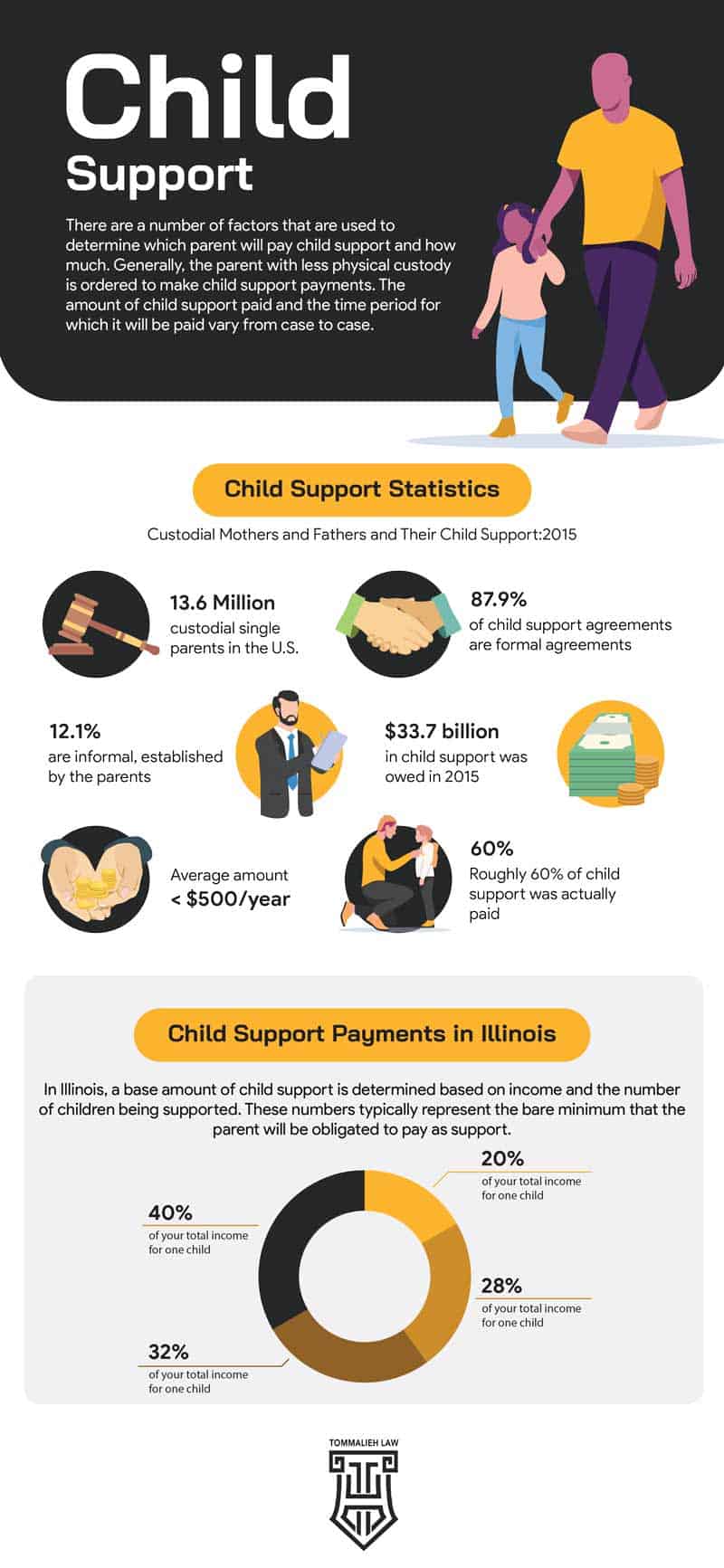
For the most part, the parent that has less physical custody of the child, regardless of legal custody, will be the party who is forced to pay child support by the support order. However, there is no universal amount that all parents who pay child support are obligated to pay.
The specific amount of the payments you make will be determined based on the number of children your payments are supporting, your income, and a whole host of extraneous circumstances that might factor into the overall needs of the children.
In Illinois, courts typically allocate a percentage of your total income for each child. This will be used to determine the base amount of child support you will have to pay. These percentages are:
- 20% of your total income for one child
- 28% of your total income for two children
- 32% of your total income for three children
- 40% of your total income for four children
It should be noted, however, that these percentages typically represent the bare minimum that a parent will be obligated to pay. There are other factors that may increase the size of these payments, such as any special needs of the child.
The parent who holds the majority of physical custody over the child will generally be assumed to already be paying the majority of the fees required to meet the child’s needs. For this reason, as discussed, the party with less physical custody is generally the party required to pay child support.
While the above percentages are simply a base value to determine the minimum child support required, the amount that one parent has already spent paying for a child’s expenses may factor heavily into both temporary and permanent support orders.

If you are a parent who is likely to end up having to pay child support payments, having experienced attorneys on your side can make all the difference. There are a lot of tricky elements at play when it comes to determining the ultimate amount that a parent will be forced to pay.
With experienced legal counsel, you can rest assured that all necessary information is being taken into account by the courts, including information provided by you and information provided by the other parent.
In turbulent custody cases, the parent receiving legal custody may often try and present their finances in a way that ensures the largest possible child support payment from the other parent. With experienced family attorneys on your team, we can make sure that everyone plays fair and that the amount determined is appropriate.
For How Long Do Parents Have to Pay Child Support?
Typically, a non-custodial parent is only going to have to pay child support until a child turns 18 and/or graduates high school. If a child turns 18 before graduating, the parent will likely have to continue paying child support until they graduate.
As well, if the child is disabled in some way that prevents them from taking care of themselves, the payments may be prolonged by the courts indefinitely. Other factors that may come into play when determining child support orders after the child turns 18 may include expenses as a result of their college education.
How Do Unemployment and Underemployment Affect Child Support Orders?
In situations wherein the parent that would typically be paying child support is either unemployed or underemployed, some special steps will be taken by the court to determine how support orders should be affected.
Firstly, the court will be forced to determine whether said unemployment or underemployment is occurring voluntarily or involuntarily. If the parent is found to be in this situation, the court will then be forced to determine whether or not is in the best interest of the child.
In most cases, it is unlikely that voluntary unemployment or underemployment will be found to be in the best interest of the child. In this case, the court is then forced to determine what that parent’s income would be if they were employed, and this imaginary income will be used to determine child support owed.
Can Child Support Orders Be Amended?
There is a good deal of extraneous circumstances that may cause child support orders to need to be amended. These modifications will need to be submitted to and approved by the courts and are typically the results of circumstances changing for either of the two parents or the child.
An increase in either income or necessary expenses may largely increase or decrease a given child support payment. As well, the increased needs of a child may greatly increase payments.

There are also non-monetary situations that may affect the size of child support payments, such as either increased or decreased physical custody.
As stated, the parent who has the greater amount of physical custody over the child is typically the parent who receives child support payments, while the parent with less physical custody is the parent making them. If the ratio of time between parents changes for any reason, this might affect the amount that must be paid.
Contact Our Cook County Child Support Attorneys for a Free Consultation
The financial aspect brought about by child support is just another complication that makes custody hearings that much more turbulent for both parents.
If you want to make sure you get a fair shake when it comes to how much child support you are eventually forced to pay to the other parent, contact us today for a free consultation.
As well, if you feel you are currently stuck in a child support order that is unfair, no longer relevant, or otherwise needs to be amended, we can help you figure out the best solution.
Our team of family lawyers in Orland Park can provide unlimited legal advice, professional mediation, contract drafting, and full representation during all of your court hearings. We will work tirelessly to ensure the fairest outcome in all situations, meaning you can put more of your focus on the emotional journey ahead.